Volatility Farming
Extracting income from price movement itself
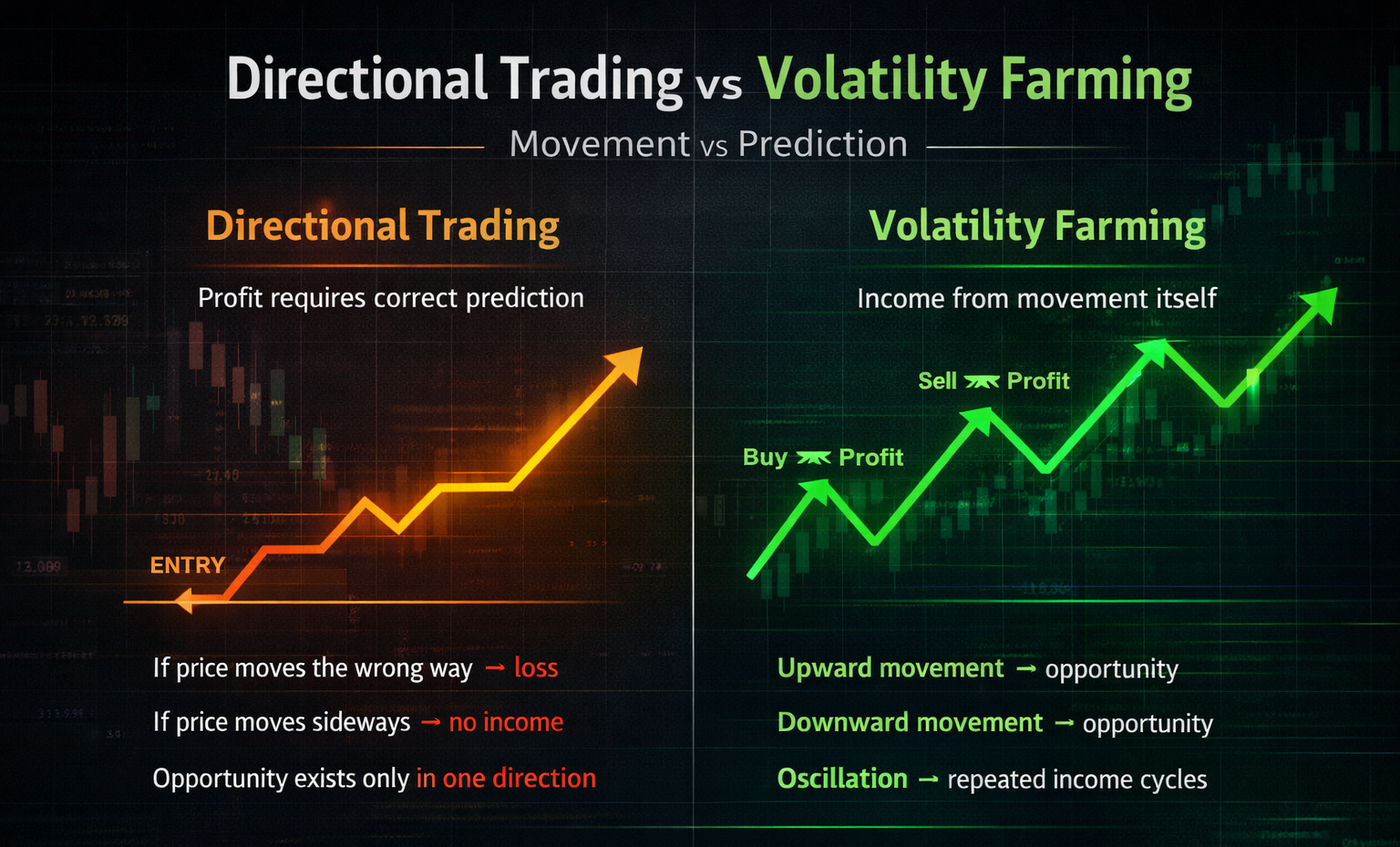
Volatility Farming (right): Income cycles arise from repeated price oscillations. Both directions contribute to the process.
Most traders attempt to predict market direction. This approach limits earning potential because profit occurs only when the prediction is correct. A long position generates returns when price rises; a short position when price falls. The requirement that price must move in the predicted direction creates a structural constraint: large portions of market movement remain unusable.
If a trader is long, downward movement becomes a threat. If a trader is short, upward movement becomes a threat. Sideways markets produce little or no income. Directional trading depends on external conditions that cannot be controlled—specifically, the requirement that price must move in the predicted direction. The strategy is binary: either the forecast is correct and profit accrues, or it is not and loss or stagnation results.
Directional Trading vs Volatility Farming
Volatility farming takes a different approach. Markets constantly oscillate as liquidity flows and participants rebalance positions. Instead of predicting where price will go, volatility farming utilizes these oscillations. Both upward and downward movements can create opportunity.
Directional trading monetizes one side of movement.
Volatility farming monetizes movement itself.
The distinction is structural. A directional strategy is exposed to half of the price path; the other half is either neutral or adverse. A volatility-farming approach is designed to capture value from displacement in either direction, treating oscillation as the primary input rather than a secondary outcome.
Market Mechanics Behind Volatility
Volatility exists for fundamental reasons: constant repricing of assets, liquidity shifts, risk rebalancing, and disagreement among participants about fair value. These forces produce continuous price adjustment. Price rarely moves in a straight line; instead it expands and contracts around temporary equilibrium levels. Each displacement creates a cycle of opportunity.
Volatility farming is the structured process of capturing value from those cycles. Position capital so that repeated displacement—in either direction—generates a defined income process. Oscillation is inherent to market structure and drives how these income cycles form.
Structural Requirements
A stable system requires controlled capital allocation, structured entry distribution, defined profit-taking logic, and tolerance for directional expansion. The system must capture oscillations without allowing volatility to destabilize the strategy.
Key risk considerations include directional exposure, capital utilization, and volatility regime changes. Parameters that perform well in one regime may underperform or overextend in another. The design must account for the possibility that volatility can expand beyond historical norms, and that capital deployed in one cycle may remain committed longer than anticipated.
Paynexor Implementation
Paynexor implements volatility farming principles through a platform designed to capture repeated market oscillations, automate structured entry and exit cycles, and operate independently of directional prediction. The system is built around parameter-driven logic that defines behavior before market stress appears, rather than reacting to price after the fact.
The implementation focuses on grid-based entry distribution, adaptive spacing, and conditional exits. Users configure allocation limits, order structure, and profit targets; the system executes according to those parameters. This approach supports repeatability and risk visibility over time. The goal is to run a process that remains understandable across different market regimes.
Markets continuously oscillate as participants rebalance risk. Directional trading attempts to predict those movements. Volatility farming converts those movements into a structured income process, systematically extracting value from the market's constant repricing.
Go deeper on risk, strategy, and platform use
Rules of Engagement walks through volatility farming, drawdown discipline, and how to read backtests with quantitative focus.