

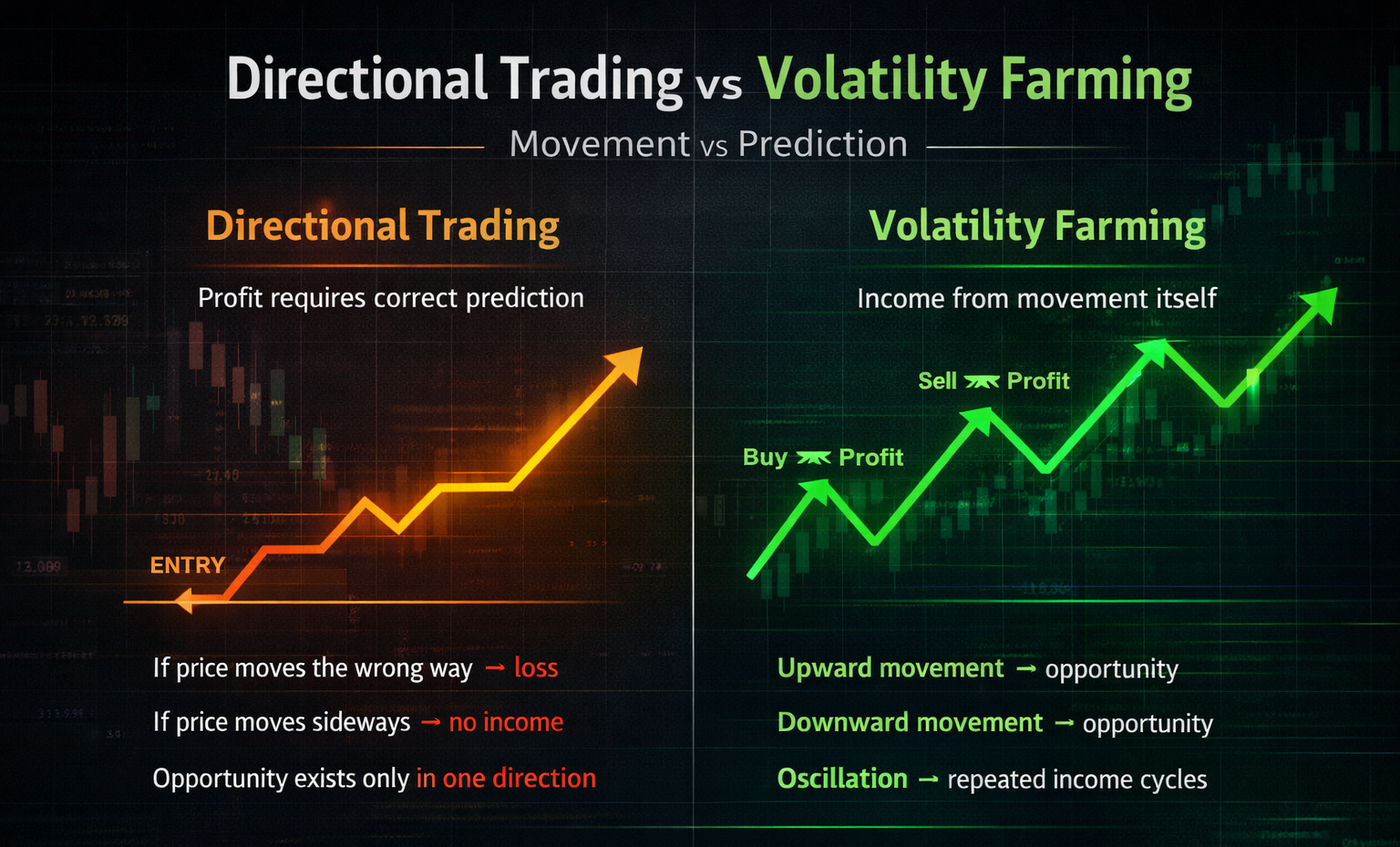
Most traders attempt to predict direction. They try to determine whether price will go up or down and position themselves accordingly. By doing this, they limit themselves. Their ability to earn becomes conditional: they only profit when price moves in the specific direction they predicted.
This reduces the number of moments when profit can actually occur. Income becomes dependent on external factors that cannot be controlled or utilized directly. The trader must wait for the market to move where they need it to move. If price moves differently—or simply moves without trending strongly—opportunity is lost.
In practice, this means large portions of market activity become unusable. If a trader is positioned long, downward movement becomes a threat instead of an opportunity. If positioned short, upward movement becomes the same. Capital remains idle while the trader waits for the market to validate their directional thesis.
Volatility farming operates on a different premise. Direction is secondary. What matters is movement.
Volatility is the rate and magnitude of price displacement. Markets rarely move in straight lines. Even strong trends contain continuous retracements, micro-reversals, and liquidity rotations. These oscillations occur because market participants constantly rebalance exposure, close positions, or enter new ones.
Each of these adjustments produces temporary price dislocations. When price moves away from a recent equilibrium level, the probability of short-term reversion increases as liquidity flows attempt to rebalance the order book.
Volatility farming is designed to systematically capture those oscillations.
Instead of committing capital to a single directional thesis, the system distributes exposure around current price levels. When price moves lower, buy positions activate. When price moves higher, sell positions activate. Profits are realized when price retraces toward previously traded levels.
In this structure, both sides of market movement become usable.
Downward movement creates buy opportunities that can close during rebounds. Upward movement creates sell opportunities that can close during pullbacks. The system converts oscillation into realized gains through repeated cycles of entry and exit.
This is why the term farming is appropriate. The trader is not predicting harvest outcomes. They are cultivating conditions that allow repeated extraction of value from an existing resource. In this case, the resource is volatility.
Every market continuously generates volatility because participants disagree on price. As new information enters the system—liquidity changes, macro events, sentiment shifts—assets are repriced. That repricing rarely occurs in a straight trajectory. It unfolds through constant expansion and contraction around temporary equilibrium points.
Volatility farming monetizes this structural behavior.
However, volatility itself is not inherently beneficial. The same movement that produces opportunity can also produce risk. If price trends aggressively without sufficient retracement, exposure can accumulate on one side of the system.
This creates what can be described as directional load. Positions begin stacking in the direction opposite to the trend. Without adequate structure, this can increase drawdown and capital utilization beyond sustainable levels.
Key structural variables include entry spacing, capital allocation, and exit distance. Entry spacing determines how frequently positions activate during price displacement. Capital allocation controls how much exposure is added during extended movement. Exit logic determines how quickly realized gains are captured during retracements.
These parameters define the system's tolerance to directional expansion.
A structure that is too aggressive may capture frequent profits but become vulnerable during sustained trends. A structure that is too conservative may remain stable but underutilize volatility and produce lower income.
The objective is to balance extraction efficiency with structural resilience.
In practical terms, volatility farming converts market oscillation into a repeatable income process. Instead of relying on the market to move in a specific direction, it leverages the market's constant movement between buyers and sellers.
The market does not remain static. Prices continuously move as participants rebalance risk. Volatility farming transforms that continuous repricing into a structured mechanism for capital rotation.
The core idea remains simple: income is derived from movement itself.
When price moves up, opportunities emerge. When price moves down, opportunities also emerge. As long as the market continues to oscillate—and all liquid markets do—volatility remains a resource that can be harvested.
The challenge is not predicting the next direction of price. The challenge is building a system capable of extracting value from volatility without allowing that same volatility to destabilize the structure of the strategy.