Most of you reading this don't know what advanced technical indicators are, nor how they work or what they mean—and you don't have to. But you should.
Knowledge is power.
Not because it sounds motivational, but because in markets, information asymmetry directly converts to capital asymmetry.
Most people operating in trading environments do not understand advanced technical indicators. They may recognize names, see colored lines on a chart, or follow signals blindly. They do not understand the mathematical structure behind them, the assumptions embedded in them, or the conditions under which they fail.
You do not strictly need to know how every indicator is derived to trade. But you should understand what it measures, what it ignores, and how it reacts to volatility, lag, and structural shifts.
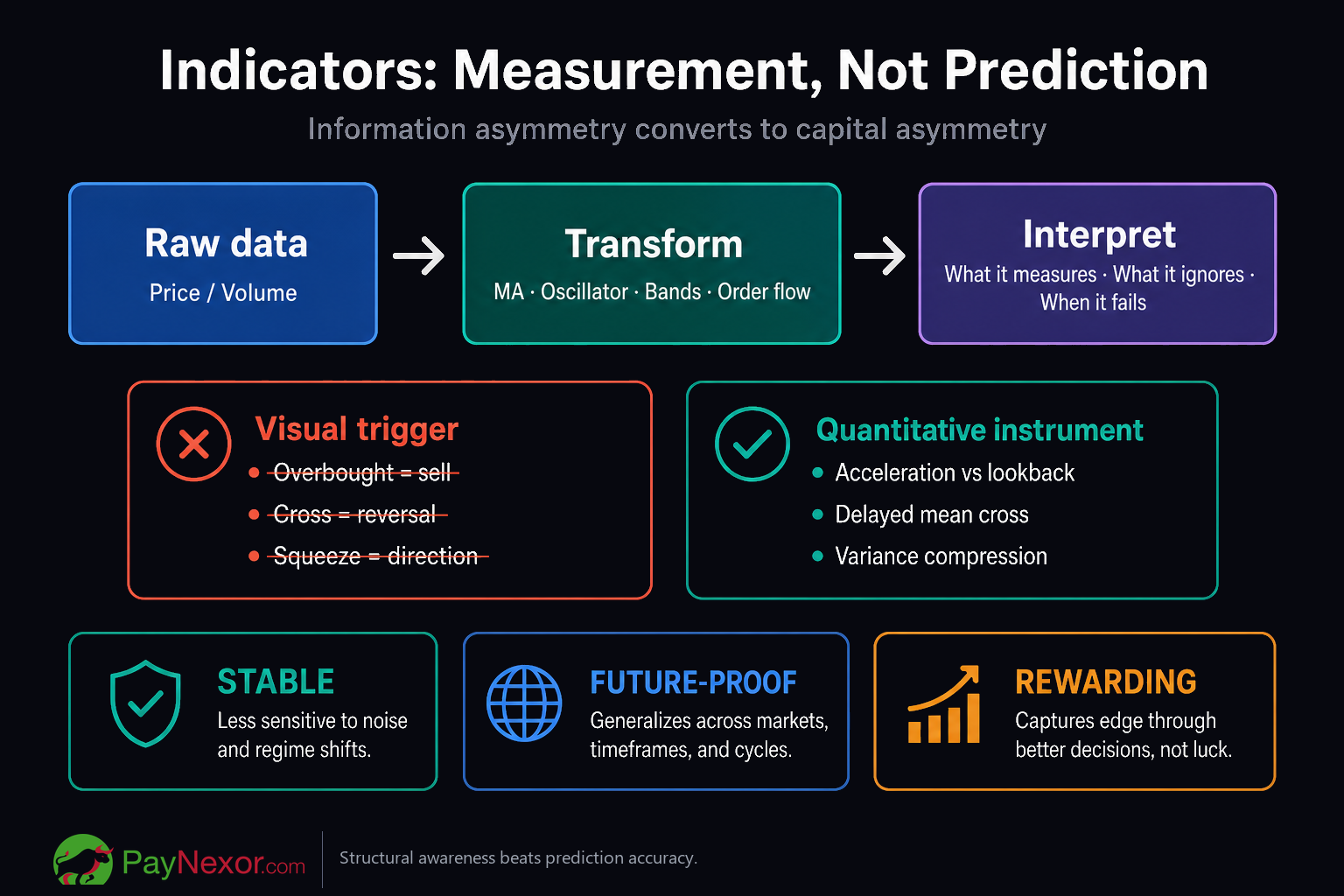
An indicator is not a prediction tool. It is a transformation of raw price or volume data. Moving averages smooth noise but introduce lag. Oscillators normalize momentum but compress extreme values. Volatility bands expand and contract based on dispersion metrics. Market profile tools approximate auction theory behavior. Order flow indicators attempt to quantify aggressor imbalance.
Without understanding the underlying math, you risk misinterpreting outputs. For example:
- A momentum oscillator reaching overbought does not mean "sell." It means relative acceleration is high compared to a lookback window.
- A moving average crossover does not signal trend reversal. It confirms that a smoothed short-term mean has crossed a smoothed long-term mean — inherently delayed.
- A volatility squeeze does not predict direction. It signals compression in variance that statistically precedes expansion.
Knowledge converts indicators from visual triggers into quantitative instruments.
The long-term objective is implementation discipline. Everything is being integrated into and implemented on PayNexor—not as decorative tools, but as structural components within a coherent framework.
That framework must be:
- Stable — meaning it does not rely on narrow parameter tuning or fragile correlations.
- Future-proof — meaning it adapts to structural evolution in markets, including increasing automation, AI-driven liquidity provision, and machine-executed arbitrage compression.
- Rewarding — meaning it produces sustainable risk-adjusted returns, not temporary spikes driven by favorable regimes.
Regarding AI trading: markets are progressively shaped by algorithmic participants. Models adapt faster than discretionary traders. If your system is static while the market structure evolves, your edge decays. A future-proof design must incorporate adaptive mechanisms — volatility-aware sizing, regime detection, parameter recalibration, and probabilistic filtering.
Knowledge enables this adaptation.
Without understanding how tools work, you cannot evaluate when they degrade. Without understanding degradation, you cannot evolve the system.
Power in trading is not prediction accuracy. It is structural awareness:
- Knowing what your tools measure.
- Knowing when they stop measuring it correctly.
- Knowing how to recalibrate.
- Knowing how to integrate multiple signals without redundancy.
When these components are embedded into PayNexor, the platform becomes more than automation. It becomes an analytical engine.
The end goal is not complexity. It is controlled sophistication. A system where advanced tools operate under defined mathematical logic, where risk is transparent, and where adaptation is engineered rather than improvised.