

Focus means disciplined, quantitative analysis: a precise understanding of what is happening, where it is happening, and why it is happening.
In trading, focus means evaluating decisions through mathematical interpretation rather than excitement, fear, or bias. Every strategy must be understood in terms of its risk profile: drawdown behavior, capital exposure, variance, dependency on market regime, and tail risk. If you do not understand how a parameter change alters risk distribution, you are not in control of the system.
When reviewing a backtest with a high win rate, the first step is not celebration but structural analysis. A high percentage can be misleading. You must determine:
- Is the performance driven by many small take-profits (TPs) filled quickly?
- Are gains clustered in short favorable periods?
- Is profitability evenly distributed across time?
- What happens during adverse volatility or regime shifts?
- How large are the losses relative to the wins?
For example, a system that produces frequent small TPs may show a high win rate while silently accumulating latent risk. If a single adverse move wipes out dozens of small gains, the strategy is structurally fragile. In contrast, a more evenly distributed equity curve with controlled drawdowns reflects a more robust risk-adjusted structure.
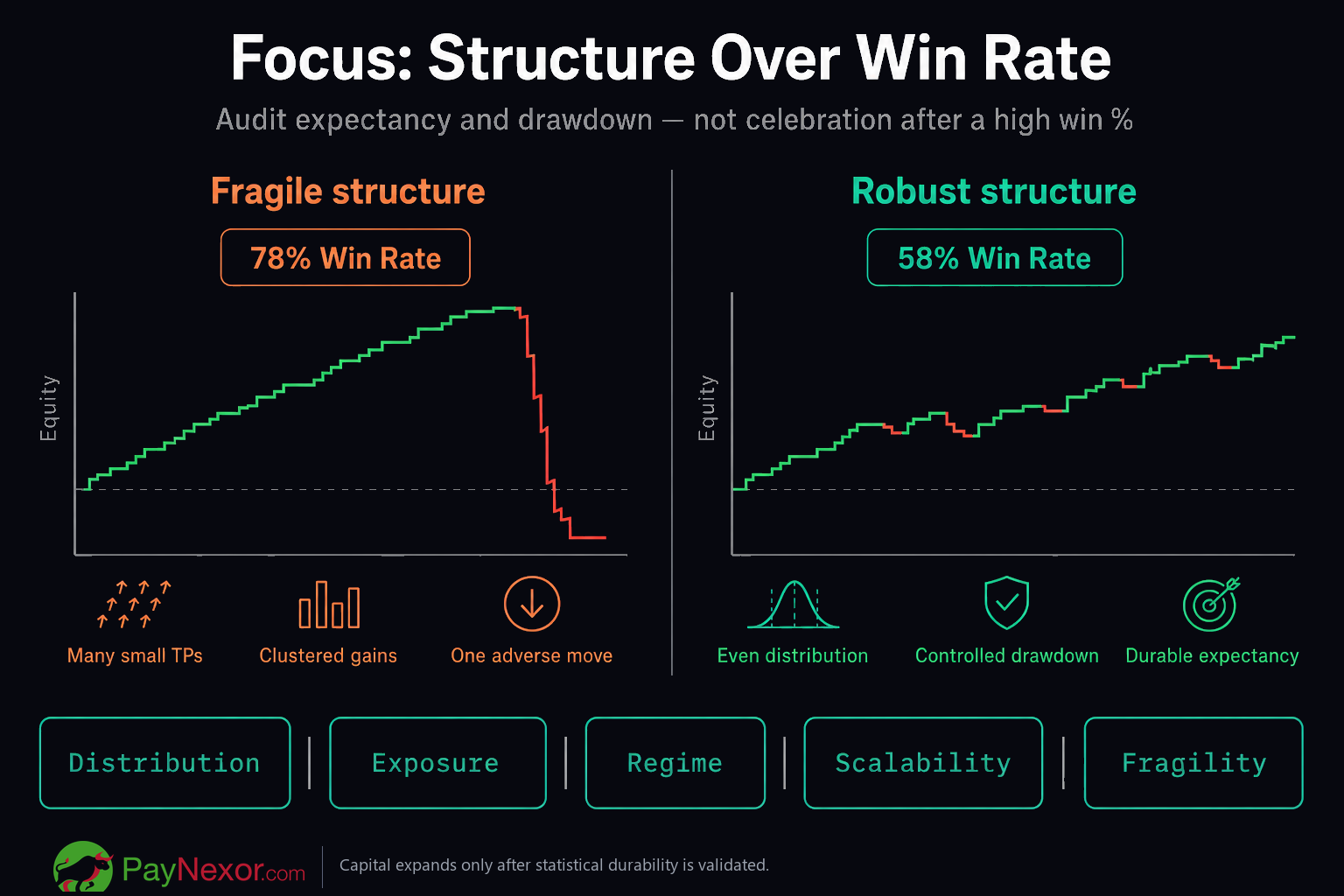
The objective is not to maximize win rate. It is to understand the relationship between expectancy, variance, drawdown depth, recovery time, and capital efficiency. True focus means identifying whether performance is statistically durable or simply the result of favorable short-term conditions.
From there, the next layer is distribution integrity.
You must stress-test the equity curve itself. Break the backtest into rolling windows and evaluate whether expectancy remains stable or decays. A system that only works in specific macro conditions is not invalid, but it requires conditional deployment. Capital should follow statistical edge, not habit.
Next, examine capital concentration. How much of total exposure is allocated to correlated positions at peak load? A portfolio can appear diversified while being structurally concentrated during volatility spikes. Correlation converges under stress. Focus requires modeling worst-case correlation expansion, not average correlation.
Then evaluate scaling behavior. Many systems degrade non-linearly as position size increases. Slippage grows, liquidity depth changes, and order book impact alters fill quality. If doubling size reduces edge by 40%, scalability is limited. Performance must be evaluated at projected capital levels, not only at current size.
Another dimension is convexity exposure. Determine whether the strategy benefits from volatility expansion or is implicitly short volatility. High win-rate systems often monetize stability. When instability arrives, loss magnitude exceeds accumulated gains. If your profit model depends on calm conditions, you must define explicit volatility thresholds for risk reduction.
Add scenario modeling. Run hypothetical shock events:
- 2x historical maximum volatility.
- Liquidity contraction by 50%.
- Funding rate extremes.
- Exchange outage during peak exposure.
If the system collapses under reasonable stress assumptions, the structure is fragile.
Focus also requires measuring opportunity cost. Capital tied in extended drawdowns reduces compounding velocity. Two strategies with equal annual return are not equal if one locks capital for months during stagnation. Time efficiency is a risk variable.
Parameter sensitivity must be tested. Slight modifications to entry spacing, take-profit distance, or risk multiplier should not collapse profitability. If minor changes destroy edge, the system is overfitted. Robust systems tolerate small deviations without structural breakdown.
Finally, evaluate psychological sustainability. Even a mathematically valid strategy fails if its drawdown frequency exceeds operator tolerance. Execution discipline deteriorates when discomfort exceeds design assumptions. Risk profile must align with behavioral capacity.
Focus, at an advanced level, becomes a continuous audit process:
- Audit distribution.
- Audit exposure.
- Audit regime dependency.
- Audit scalability.
- Audit fragility.
Only after these layers are validated does increasing allocation become rational.
Earning more is not about pushing parameters for higher nominal return. It is about tightening structural control until variance becomes predictable within defined boundaries. When uncertainty is measured, capital can expand safely.
Anything outside that framework is temporary performance.