

A bear is a specific period in which price action on average tends toward the lower side of the Y-axis, usually comparatively to other periods. A bull is the opposite of that.
The terms are often reduced to sentiment labels. In reality, they describe statistical directional bias in price behavior over a defined period.
A bear market is not simply "price going down." It is a regime in which, on average, price movements skew toward the lower side of the Y-axis relative to prior periods. That means negative returns occur more frequently, or with greater magnitude, than positive ones. The distribution of returns shifts downward.
A bull market is the inverse condition. The average directional bias skews upward. Positive returns dominate either in frequency, magnitude, or both.
At the transactional level, this reflects aggregate order flow imbalance.
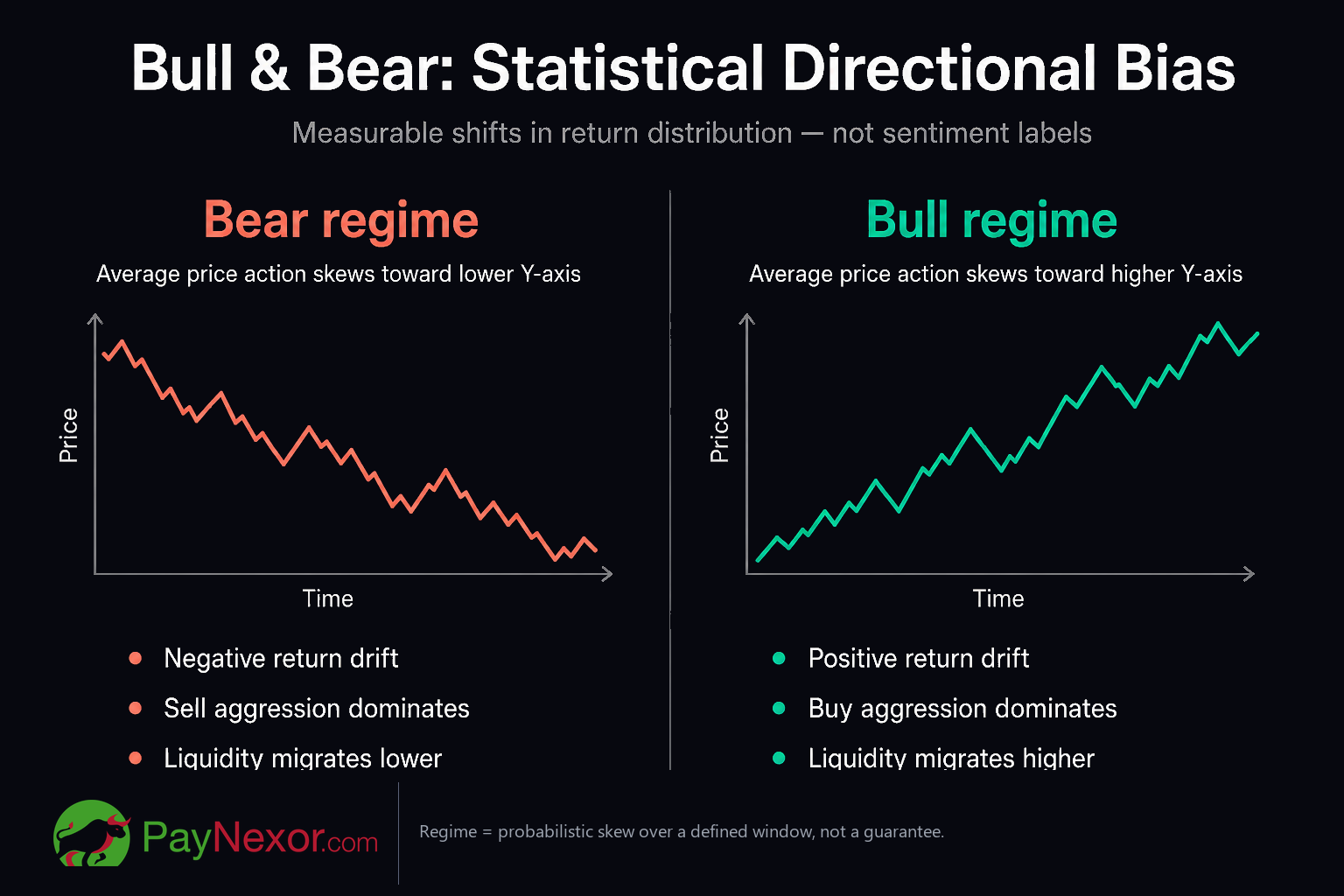
In a statistically bearish phase:
- Market sell orders hit the bid more aggressively.
- Limit buy liquidity is absorbed faster than it replenishes.
- Lower price levels are accepted repeatedly.
- Sellers are more urgent than buyers.
This does not mean there are "more sellers than buyers" in count. Every trade has a buyer and a seller. What changes is aggressiveness and price concession. Sellers are willing to accept progressively lower bids. Buyers demand discounts before committing size.
As this behavior repeats, the order book shifts downward. Bids thin out at higher levels. Offers stack closer to current price. Liquidity migrates lower. The fair value range reprices.
Statistically, this manifests as:
- Negative drift in returns.
- Lower highs and lower lows.
- Increased probability of downside continuation after retracements.
- Expansion in downside volatility relative to upside.
In a bullish phase:
- Market buy orders lift the offer consistently.
- Limit sell liquidity is consumed faster than it rebuilds.
- Higher price levels are accepted.
- Buyers are more aggressive and less price-sensitive.
Again, it is not about volume count but about pressure asymmetry. Buyers cross the spread with urgency. Sellers become passive, waiting for higher prices.
The order book reflects this through:
- Thicker bids stepping up.
- Offers being pulled or lifted quickly.
- Upward migration of liquidity clusters.
- Breakouts holding rather than failing.
Over time, this produces:
- Positive return drift.
- Higher highs and higher lows.
- Increased probability of upside follow-through.
- Upside volatility expanding relative to downside.
Crucially, bull and bear are probabilistic environments, not guarantees. Even in a bear regime, upward rallies occur. The defining characteristic is statistical skew: the mean and median outcomes tilt in one direction.
Another important dimension is timeframe. A market can be bearish on a daily scale while bullish on a yearly scale. Directional bias is always relative to the observation window.
From a structural perspective, bull and bear describe capital allocation preference. In bullish conditions, participants increase risk exposure. In bearish conditions, capital rotates toward safety, liquidity, or alternative assets.
In practical terms, identifying a bull or bear regime means identifying:
- Drift direction in rolling return averages.
- Persistence of directional momentum.
- Asymmetry in order flow aggression.
- Volatility expansion bias.
They are not emotional labels. They are statistical states of imbalance between bid and ask pressure over time.
When understood this way, bull and bear are not opinions. They are measurable shifts in distribution and liquidity behavior.